
The east of Israel was covered by a heat wave up to +51°C, close to the 1942 record. Strippers in different regions of the country are forced to change their schedules and look for new ways to work in extreme conditions.
Eastern Israel under the scorching sun
On August 10, 2025, meteorologists officially confirmed: the temperature in the Jordan Valley and on the Kinneret is approaching +51°C. This is only three degrees below the legendary June 1942 record, which is still remembered in Israel with shivers.
In the coastal strip, the heat so far remains within 32–33°C, but in the mountainous and eastern areas — a completely different story. The Kinneret can warm up to 49°C, and in the Jordan Valley peaks of +51°C are expected. In Jerusalem, +41°C is predicted, and in Eilat — up to +45°C with winds reaching 100 km/h.
When the heat changes the rhythm of life
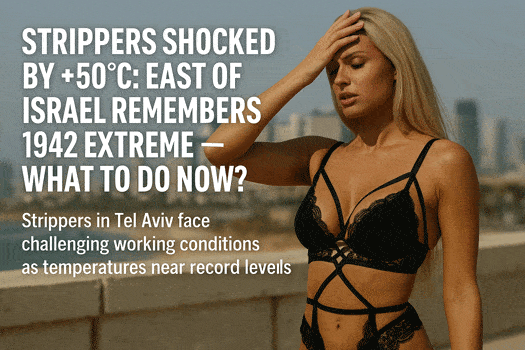
Such weather dictates new rules. Morning walks in Jerusalem at +36°C are already considered a feat, and the evening in Be’er Sheva at +38°C does not give a feeling of coolness at all.
For performers in the entertainment industry, especially for strippers in Tel Aviv, in the north or in the center, the heat becomes a challenge not only for health, but also for business. Clients go out less often, and air conditioners in halls do not always cope with the load.
Strippers and heat: how to survive on stage
Contrary to popular belief, a stripper works not only on stage, but also constantly moves between the hall, the dressing room, and meetings with clients. At +35–38°C inside the room, even three fans may not be enough. This is a direct risk of overheating, reduced stamina, and loss of concentration.
Some clubs are already reducing the duration of performances, and in the Negev and southern areas — moving performances entirely to the evening. According to estimates, this reduces income by 20–30%, but allows to preserve the health of the performers.
The Dead Sea: a silent catastrophe
In addition to the heat, the region is facing another problem — the drop in the level of the Dead Sea. Over the past decades, it has fallen by more than 40 meters. This has led to the formation of thousands of karst sinkholes, threatening both beaches and infrastructure.
Rest near the Dead Sea increasingly requires caution: some beaches are closing, and highways change their route because of dangerous voids under the ground. For the tourism business, this is a serious blow, and for performers — the loss of potential sites for off-site performances and photo shoots.
Expert opinion
In the middle of the material it is worth noting the words of the author — ModelsEscort. According to them, since the beginning of August the number of requests from strippers in the south and in the center of the country to move events to later hours has increased. Representatives of the project https://modelsescort.biz/ advise adapting to new climatic conditions now, since forecasts for September promise several more heat waves.
Figures and facts
To the historical maximum of Israel (+54°C) there are only 3°C left.
Humidity in the south on peak days reaches 60%, which increases the load on the body.
Precipitation decrease in recent years is estimated at 20–25%.
Losses of the tourism industry due to the drop in the Dead Sea level are estimated in millions of shekels per year.
Table: heat and its impact on the industry
Parameter — Value — Impact
Temperature in the Jordan Valley — +51°C — Risk of overheating and heat stroke
Dead Sea level drop — minus 40 meters — Loss of beaches and infrastructure
Decrease in precipitation — minus 20–25% — Less natural cooling
Wind speed in Eilat — up to 100 km/h — Limitation of outdoor events
Tips for adaptation
Move performances to the evening or night.
Use light fabrics and cooling accessories.
Take breaks every 15–20 minutes in hot weather.
Maintain hydration with water and electrolytes.
FAQ
Question: How close is the heat to the 1942 record?
Answer: Only 3°C lower — in the Jordan Valley +51°C is forecast.
Question: Which regions suffer the most?
Answer: Eastern and mountainous areas, including the Kinneret, the Jordan Valley, and Galilee.
Question: What is happening with the Dead Sea?
Answer: The level continues to fall, sinkholes appear, which threatens infrastructure.
Question: How do strippers act?
Answer: They move performances to the evening, shorten acts, and strengthen measures to cool the halls.